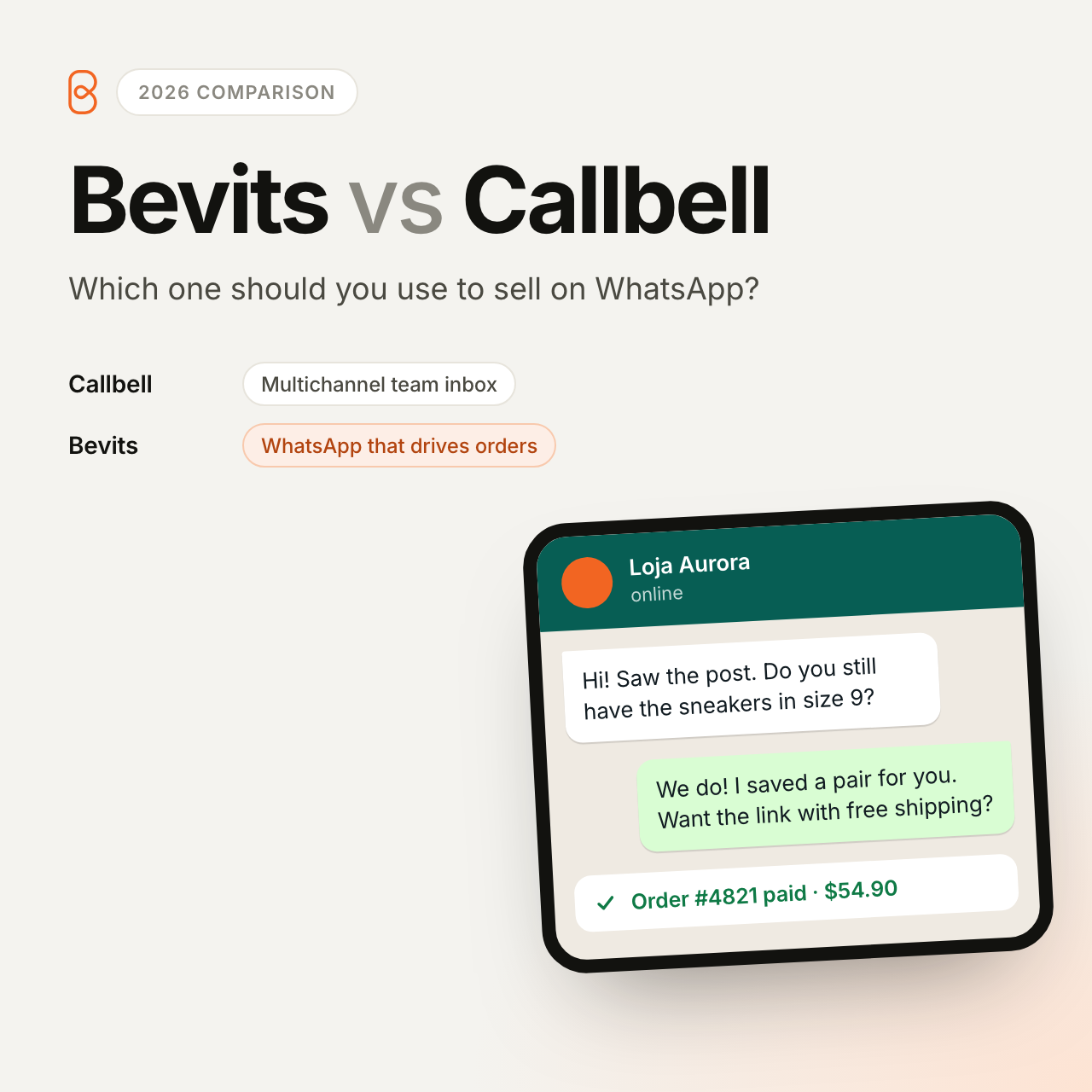
If you are looking for a way to organize your company’s WhatsApp, Callbell has probably shown up in your search. It is a popular multi-agent inbox that brings WhatsApp, Instagram, Messenger, Telegram and other channels into one screen, and it says more than 75,000 companies use it.
Bevits also works with WhatsApp, but it starts from a different place: the online store. In this comparison we put Bevits and Callbell side by side using public information as of October 2026. Yes, we are Bevits. That is exactly why we made a point of showing where Callbell wins.
Who this comparison is for: Bevits is built for online stores in Brazil and Latin America, integrates with regional platforms such as Nuvemshop and Bling, and charges in Brazilian reais (BRL). Callbell is a global tool priced in US dollars and euros. If your business operates outside Latin America, Callbell will probably serve you better.
Which is better, Bevits or Callbell?
- Pick Callbell if you need a support inbox for a team of several agents, want to bring many channels together (WhatsApp, Instagram, Messenger, Telegram, TikTok and website chat), need mobile and desktop apps, and connect other tools through Zapier.
- Pick Bevits if you sell on WhatsApp and run an online store in Brazil or Latin America, and you want conversations to end in a paid order: AI that builds the cart and quotes shipping, abandoned cart recovery, post-purchase flows, repeat purchases and revenue measured per automation, with WhatsApp, email and SMS in one place.
In one sentence: Callbell organizes customer service across many channels. Bevits uses your store data to sell more on WhatsApp.
Quick Scorecard
| Criterion | Callbell | Bevits |
|---|---|---|
| Number of channels Messenger, Telegram, TikTok and website chat on top of WhatsApp and Instagram | ✓ Wins | |
| Entry cost for small support teams Per-user pricing and a free chat widget; Bevits starts at R$249 | ✓ Wins | |
| Mobile and desktop apps Android, iOS, Windows and macOS | ✓ Wins | |
| Generic integrations and global reach Official Zapier app, API, webhooks; USD and EUR pricing | ✓ Wins | |
| Native store integration Nuvemshop, Shopify, WooCommerce and Bling | ✓ Wins | |
| AI that sells on WhatsApp Builds the order, quotes shipping and sends the checkout link | ✓ Wins | |
| Abandoned cart, post-purchase and repeat sales | ✓ Wins | |
| Revenue attributed per automation | ✓ Wins | |
| WhatsApp, email and SMS in one CRM With RFM segments and cashback (giftback) | ✓ Wins | |
| Campaign costs with included volume Callbell's broadcast module charges per contact reached | ✓ Wins | |
| Multi-agent inbox with teams | Tie | Tie |
| WhatsApp Coexistence (app + API on one number) | Tie | Tie |
What Is Callbell?
Callbell is a messaging platform for customer service and sales built around a shared team inbox. It brings together WhatsApp, Instagram Direct, Facebook Messenger, Telegram, TikTok and a website chat widget, with automatic routing to departments, team analytics and apps for Android, iOS, Windows and macOS.
Beyond the inbox, it offers a chatbot builder (the advanced bot module is a paid add-on), WhatsApp broadcasts with CSV contact import, an API, webhooks and an official Zapier integration. In 2026 Callbell launched an AI agent that can run inside bot flows, and it keeps shipping features such as WhatsApp Flows and WhatsApp calls in the mobile app. It is a mature tool and easy to get started with.
What Is Bevits?
Bevits is a marketing and sales automation platform for ecommerce, focused on WhatsApp. It was born from the store’s orders, not from the inbox. That is why it starts with the data that matters most to merchants: customers, purchases, carts and revenue. It was created in Brazil, focuses on Brazil and Latin America, and offers its interface and docs in Portuguese, Spanish and English.
In practice, Bevits brings together:
- Official WhatsApp (Meta’s API), with campaigns, multiple numbers, Coexistence and per-customer tracked links.
- AI-powered support that answers questions, understands voice notes, finds products from a photo, builds the order and hands off to a human when needed.
- Revenue automations: abandoned cart, post-purchase, win-back, birthday and cashback (giftback).
- A CRM with RFM segments, attributes and purchase history.
- Email and SMS in the same flow as WhatsApp.
- Instagram: DMs in the inbox and comment-to-DM automation.
- Native integrations with Nuvemshop, Shopify, WooCommerce and Bling.
Bevits vs Callbell: Detailed Comparison
1. WhatsApp: both use the official API
Callbell is an official WhatsApp Business Partner, and Bevits connects through Meta’s Embedded Signup. Either way you use the official API, with approved templates and without the ban risk of unofficial connections.
The difference is the job WhatsApp does:
- In Callbell, WhatsApp is one of the inbox channels. The focus is organizing support: several agents on the same number, routing by department, replies, broadcasts and bots.
- In Bevits, WhatsApp is the center of the sales operation. The AI knows your catalog, looks up orders, quotes shipping and, on Nuvemshop, builds the cart and sends the checkout link inside the conversation. Campaigns use store segments, and every link sent is tracked per customer, with clicks and per-button performance.
Both support WhatsApp Coexistence, which lets you use the same number in the phone app and in the platform at the same time. Keep in mind that Meta does not offer Coexistence in some regions, such as the European Union and the United Kingdom. Want to learn how it works? Read our WhatsApp Coexistence guide.
2. Channels and support: Callbell’s advantage
Callbell is ahead here. It handles WhatsApp, Instagram, Messenger, Telegram, TikTok and website chat in one inbox, and it has mobile and desktop apps so your team can reply from anywhere. You can also connect several accounts per channel, paying for each extra account.
Bevits covers the channels that sell the most for ecommerce in Brazil and Latin America: WhatsApp, Instagram, email and SMS, plus capture popups. The inbox has teams, automatic conversation assignment (it remembers each customer’s preferred agent), quick replies with images and buttons, and a template to restart the conversation after the 24-hour window. On the other hand, Bevits has no mobile app, no Messenger, Telegram or TikTok, and no internal notes in the inbox.
If your operation is mostly support across many channels, Callbell is likely the better fit.
3. Ecommerce: where Bevits plays at home
This is the biggest difference. We could not find a native Callbell integration with Shopify, Nuvemshop or WooCommerce on its official website. You can connect a store through the API or Zapier, but order and cart data do not show up ready to use inside the tool.
With your store connected, Bevits syncs products, customers and orders and uses that data everywhere:
- Abandoned cart recovery via WhatsApp, email and SMS, with a coupon if you want.
- Post-purchase and repeat sales based on what the customer bought and when.
- RFM segments (recency, frequency and monetary value) to talk to champions, at-risk customers and those who have gone quiet. Learn more in our RFM matrix guide.
- Cashback (giftback) to bring customers back.
- Attributed revenue at every automation step, with sends, deliveries, clicks, conversions and coupon results.
For online sellers, this answers the question store owners ask the most: “how much money did this automation bring in?”
4. Artificial intelligence
In June 2026 Callbell launched a configurable AI agent: you set a goal, tone of voice, knowledge base and forbidden rules, test it in a simulator and drop it into a bot flow. According to the official changelog, it already understands voice notes, images and documents, can update contacts and conversations, and has performance and cost reports. Usage consumes AI credits, and every account gets $5 in credits to start.
Bevits’ AI is built to sell and support customers on a store’s WhatsApp:
- understands voice notes;
- finds products from a photo sent by the customer;
- looks up orders and quotes shipping;
- builds the order and sends the checkout link (Nuvemshop);
- handles pre-service triage with messages and interactive options;
- learns from conversations, and you can review and edit what it learned;
- can be turned on or off per WhatsApp number.
In short: Callbell’s AI is more generic and flexible; Bevits’ AI comes connected to your store’s catalog and orders.
5. Pricing: per user or per plan
| Item | Monthly price | What's included |
|---|---|---|
| Callbell Multiagent Chat | $15 per user | Inbox, WhatsApp, Instagram, Messenger, app |
| Callbell Multiagent Chat Plus | $20 per user | Advanced analytics, API, integrations |
| Callbell WhatsApp | From $22 | Consumable WhatsApp credits |
| Callbell broadcasts | $0.02 per contact | WhatsApp campaign module |
| Callbell Advanced Bot | $65.55 | Advanced chatbot builder |
| Callbell Enterprise | Custom | 50+ agents, ChatGPT, SAML/SSO |
| Bevits Pro | R$249 | Unlimited contacts, 500 WhatsApp, 300 SMS, 5,000 emails |
| Bevits Ultra | R$499 | 10,000 WhatsApp, 500 SMS, 20,000 emails |
How Callbell charges: per user (agent) per month, plus channels and add-ons. The pricing page lists WhatsApp as consumable credits from $22 a month, each extra channel account at $22, the broadcast module per contact reached and the advanced bot as a separate add-on. The calculator on the site shows a 3-month minimum commitment. Sign-up is free, and the website chat widget stays free after the 7-day trial.
How Bevits charges: a flat plan in BRL with unlimited contacts and WhatsApp, SMS and email volumes included. Beyond that, you use credits. There is a 7-day free trial and no permanent free plan.
Which one is cheaper? A small team that only answers customers on WhatsApp may spend less on Callbell: two agents on the base plan plus WhatsApp credits come to roughly $52 a month. The math changes once campaigns and sales automations come in. With Callbell, each broadcast adds $0.02 per contact and the advanced bot costs $65.55 on top. With Bevits, campaigns, automations, email and SMS are already in the plan. Run the numbers with your own team and audience size.
6. Ecosystem, integrations and API
Callbell has an official Zapier integration, an API and webhooks to connect CRMs, ERPs and other tools. That gives flexibility to teams that already have a defined stack.
Bevits does not yet offer Zapier, Make or outbound webhooks. In exchange, the integrations that matter for ecommerce in Brazil (Nuvemshop, Shopify, WooCommerce and Bling) are native and need no technical setup. Bevits also offers a read-only public API and an MCP server, so AI agents such as Claude and ChatGPT can securely look up customers, purchases and campaigns.
7. Language, support and market
Callbell operates worldwide, with prices in US dollars, euros and Brazilian reais. Bevits was created in Brazil. Its operation, support and integrations (Nuvemshop, Bling, BRL pricing) were designed for Brazilian and Latin American stores, with human support in Portuguese. If you sell in North America, Europe or Asia, Callbell is the more natural choice.
When to Choose Callbell
- You need a support inbox for a team of several agents.
- Your customers reach you on Messenger, Telegram, TikTok or website chat, not just WhatsApp.
- Your team needs mobile and desktop apps.
- You use Zapier or the API to connect CRMs and ERPs.
- You operate outside Latin America, or WhatsApp is more about support than sales.
When to Choose Bevits
- You run an online store in Brazil or Latin America (Nuvemshop, Shopify, WooCommerce) or use Bling.
- WhatsApp is your main sales and support channel.
- You want AI that sells, not just AI that answers questions.
- You want to recover carts, run post-purchase flows and drive repeat sales on autopilot.
- You need to know how much revenue each automation generated.
- You want WhatsApp, email and SMS in one place, with predictable costs and no per-contact fees.
Can You Use Both?
Yes. Some businesses keep Callbell for multichannel support (Messenger, Telegram, TikTok, website chat) and use Bevits for WhatsApp sales, with campaigns, abandoned carts and repeat purchases. The main thing to watch is not connecting the same WhatsApp number to both platforms. Use different numbers, or pick one of them to own your official WhatsApp number. If Instagram matters to you too, see our Bevits vs Manychat comparison.
How to Move from Callbell to Bevits
- Connect your store (Nuvemshop, Shopify, WooCommerce or Bling) to sync customers and orders.
- Export your Callbell contacts that aren’t in your store and import them into Bevits via spreadsheet (CSV).
- Connect official WhatsApp. With Coexistence, you can keep the number you already use in WhatsApp Business.
- Recreate your templates and quick replies in the Bevits inbox and set up your team.
- Turn on the ready-made automations: abandoned cart, post-purchase and win-back.
- Set up the AI with your store’s tone of voice, policies and FAQs.
Before moving your WhatsApp number, disconnect it from Callbell. A number can only be linked to one API platform at a time.
Frequently Asked Questions
Is Bevits a Callbell alternative?
Yes, especially for online stores in Brazil and Latin America that sell on WhatsApp. Callbell is a strong multi-agent inbox for many channels; Bevits turns conversations into paid orders and repeat purchases, with native store integrations, AI that builds the order and revenue attributed to each automation.
Which is cheaper, Bevits or Callbell?
It depends on your team and campaigns. Callbell starts at $15 per user, plus WhatsApp credits (from $22) and $0.02 per contact in broadcasts. Bevits starts at R$249 with unlimited contacts and WhatsApp, email and SMS included. A small support-only team may pay less with Callbell; stores running campaigns and automations usually get more predictable costs with Bevits.
Does Callbell use the official WhatsApp API?
Yes. Callbell is an official WhatsApp Business Partner, connects through Meta’s Cloud API and supports Coexistence.
Does Callbell integrate with Shopify or Nuvemshop?
We could not find a native integration on its official website. It offers an API, webhooks and Zapier, which let you connect a store with some setup. Bevits integrates natively with Nuvemshop, Shopify, WooCommerce and Bling.
Can I keep my WhatsApp Business number when moving to Bevits?
Yes. Bevits supports WhatsApp Coexistence: you connect the number you already use, keep replying from your phone, and conversations show up in the Bevits inbox. Disconnect the number from Callbell first.
Can I use Bevits and Callbell together?
Yes, with different WhatsApp numbers. Use Callbell for support on Messenger, Telegram and TikTok and Bevits for WhatsApp sales, abandoned carts, post-purchase and repeat sales.
Conclusion
Callbell is a good choice for organizing a team’s customer service across many channels, with apps, Zapier and a low entry price. If that is what you need, especially outside Latin America, it will serve you well.
If your goal is to sell more on WhatsApp in Brazil or Latin America, with your store connected, AI that closes orders and automations that show exactly how much revenue they generated, Bevits was built for exactly that. Try it free for 7 days and compare it against your own numbers.
Disclosure: this article was written by the Bevits team. Information about Callbell comes from its official website, pricing page, Coexistence guide and official changelog, checked in October 2026, and may change without notice. Spotted something out of date? Let us know and we’ll fix it.